Wet Food or Dry Food: What’s Better for Your Cat?
Wet food or dry food – hardly any question is discussed more often among cat owners. Some swear by a bowl full of juicy meat, others appreciate the convenience of small kibbles. And your cat? They probably have a very clear opinion on the matter too.
In this article, we’ll take a closer look at both options: what defines them, where their strengths lie, and what you should really pay attention to when making your decision. Without dogma, but with a focus on what cats naturally need.
The Crucial Difference: Water
The biggest difference between wet food and dry food isn’t the taste, but the water content.
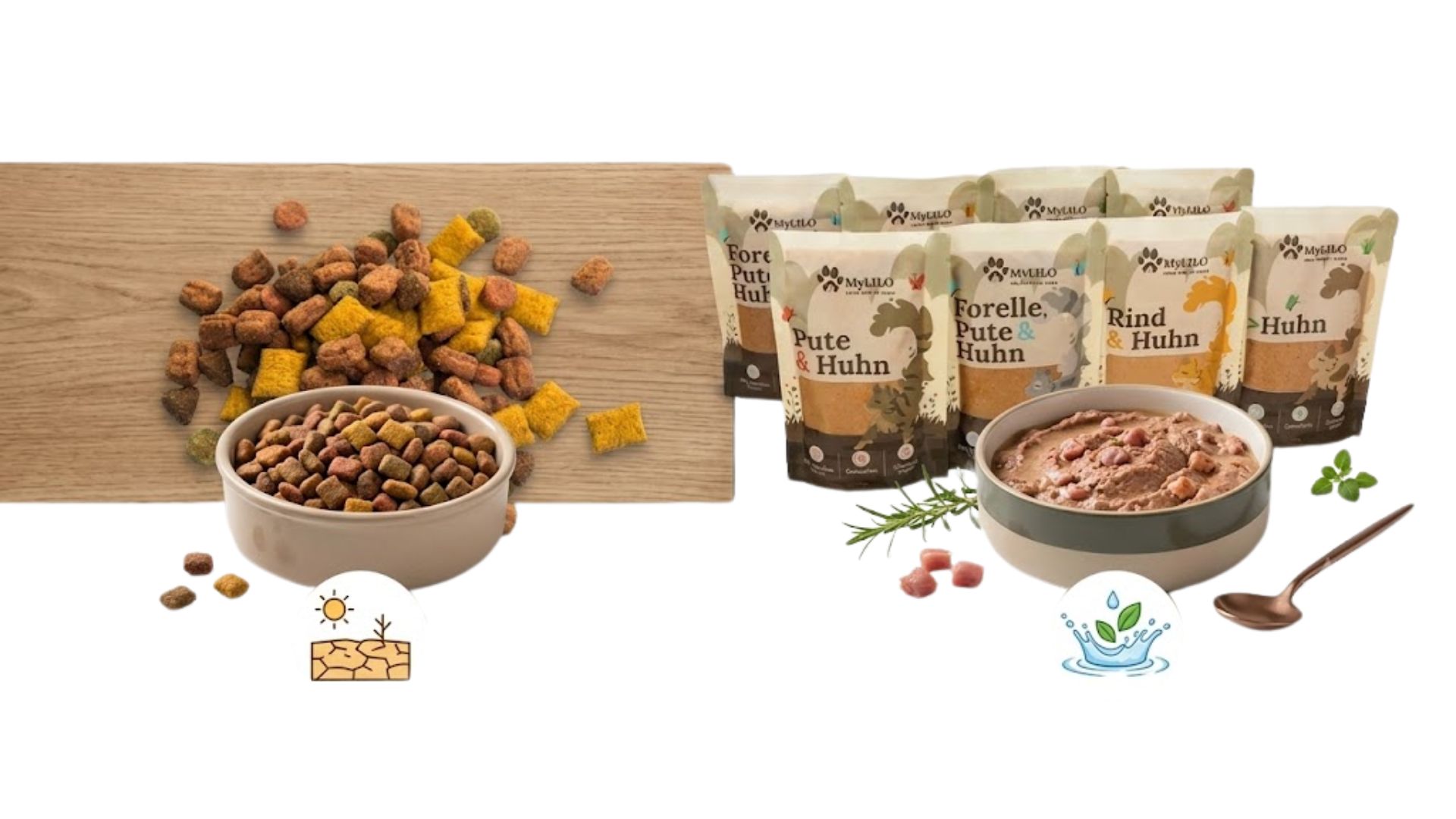
Wet food consists of about 70 to 82 percent water. Dry food contains around 5 to 10 percent. That sounds like a technical detail, but it’s the core of the entire discussion.
Because cats originally descended from desert animals. Their ancestors met most of their fluid needs through prey, not from water sources. That’s why cats still have a weak sense of thirst today. They simply don’t drink very much, even when fresh water is right next to them.
If your cat eats mainly dry food, they must actively compensate for this water deficit through the water bowl. Many cats only manage this partially.
Wet Food: The Advantages
High fluid intake. Your cat automatically takes in water with every meal. This relieves the kidneys and urinary tract – two areas where cats are naturally vulnerable.
Closer to the natural prey pattern. Consistency, meat content, and moisture come close to what a cat would eat in the wild.
Usually better accepted. Wet food smells more intense and simply tastes more interesting to most cats.
Fills them up with fewer calories. Due to the water content, the portion is larger, but the calorie count is lower. This helps with cats that tend to be overweight.
Wet Food: The Disadvantages
Shorter shelf life in the bowl. Opened food shouldn’t be left out for hours, especially not in summer.
More packaging and more storage space. However, this can be significantly reduced with recyclable pouches instead of cans.
Higher price per meal. At first glance, at least. If you factor in quality and meat content, this quickly balances out.
Dry Food: The Advantages
Practical and long-lasting. Once portioned out, it keeps easily and can be portioned well.
Good for automatic feeders and long absences. If you’re away from home for twelve hours, there’s less logistical effort here.
Cheaper per kilogram. That’s a real argument for many households.
Dry Food: The Disadvantages
Very low water content. That’s the big sticking point. Many cats don’t fully compensate for this through drinking.
Often high grain or carbohydrate content. Cats are pure carnivores. They need animal protein, not large amounts of grain.
Easy to overfeed. The kibbles are calorie-dense and small amounts look like very little. A few handfuls too much are hardly noticeable, but they show up on the scale.
The myth about teeth. Dry food doesn’t clean teeth. Most cats barely chew the kibbles, they swallow them. It doesn’t replace real dental care.
Can You Combine Both?
Yes, many households do this – and it’s better than pure dry food. The important thing is that you keep track of the total amount. Feeding both in full portions quickly leads to overweight.
A sensible option: wet food as the basis of nutrition, dry food only as a small supplement or as a snack. And in any case: multiple water stations in the home, ideally far away from the food bowl.
How to Recognize Good Wet Food
Not every wet food is automatically high-quality. These points will help you compare:
- High animal content. Meat, organs, and fish should be at the top of the ingredient list.
- Clear declaration. “Chicken 60%” is a statement. “Animal by-products” is not.
- No sugar, no colorants, no unnecessary fillers.
- Gentle preparation. If the food is heated too hot and for too long, nutrients and flavor are lost.
- Sustainable packaging. Recyclable stand-up pouches are significantly more economical in production and transport than cans.
Our Answer to the Question
If you ask us: Wet food should be the basis of nutrition. It fits better with what a cat naturally needs, and it solves the water problem along the way.
That’s exactly why MyLILO Cat Food exists. Our food consists of 98 percent animal protein and is gently cooked, meaning so carefully that flavor and nutrients are preserved. Without chemical preservation, without unnecessary additives. Like homemade, just without the effort.
It’s available in four varieties: Chicken, Beef, Turkey, and Trout. If you’re unsure what your cat likes best, the Starter Pack is a good start – it includes all varieties.
Common Questions About Wet Food or Dry Food
Is wet food or dry food better for cats?
For most cats, wet food is the better basis because it contains around 80 percent water and thus supports the kidneys and urinary tract. Dry food is more practical and cheaper, but barely covers fluid needs. A combination is possible, as long as the total amount is right.
Can I mix wet food and dry food?
Yes, that’s generally possible. Just make sure that both amounts together don’t exceed your cat’s daily requirement. It’s best to give both at different times and not in the same bowl.
Does my cat drink too little if they only eat dry food?
Very likely yes. Cats have a weak sense of thirst and often don’t fully compensate for the missing water content. If you mainly feed dry food, you should offer multiple water stations or set up a drinking fountain.
Does dry food really clean my cat’s teeth?
No, this effect is greatly overestimated. Most cats swallow the kibbles instead of chewing them. For healthy teeth, regular checkups at the vet and appropriate dental care are much more effective.
How do I recognize high-quality wet food?
Look for a high and clearly declared meat content, no sugar, no colorants, and few plant-based fillers. Preparation also counts: gently cooked food retains more nutrients and flavor than heavily heated food.